Industry Leaders Form the Blueprint Alliance to Advance a Shared Architecture for Securing AI Agents
Cross-industry coalition spanning identity, AI, data, applications, infrastructure, cybersecurity, and strategic
Press Release Disclaimer: This is a press release distributed through the XPR Media network. It has not been independently verified by our newsroom.


For AI agents to drive better outcomes, they need to reason, act, and connect across model providers, data platforms, SaaS applications, networks, and infrastructure. This interconnected agentic stack requires vendors to come together to close an identity gap where shadow agents multiply, credentials cross trust boundaries, and agents execute beyond their intended scope. That gap will only widen: Gartner predicts that by 2028, an average global Fortune 500 enterprise will have over 150,000 agents in use, while only 13% of organizations think they have the right AI agent governance in place.
This press release features multimedia. View the full release here: https://www.businesswire.com/news/home/20260922940845/en/
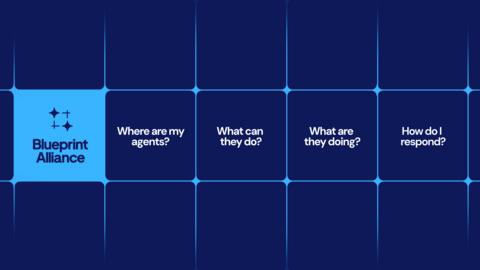
Four core challenges every secure agentic enterprise must address
Today, Okta, together with Amazon Web Services (AWS), CrowdStrike, Databricks, Docker, Google Cloud, Lovable, Proofpoint, Salesforce, ServiceNow, Wiz, and Zscaler, announced the formation of the Blueprint Alliance, a cross-industry coalition formed to help organizations operate their agentic stack as a unified, governed system.
Founding Alliance members have aligned toward a shared set of principles for securing AI agents — treating every agent as a first-class identity, scoping access to the task rather than granting standing access, keeping delegation traceable, monitoring runtime behavior continuously, enabling containment that is instant and reversible, and ensuring governance adapts at the speed AI moves.
Guided by these principles, the Alliance evolved and expanded the blueprint for the secure agentic enterprise, first introduced in March 2026, into an open, multi-vendor reference architecture. It provides organizations with a standardized way to address four core challenges: Where are my agents? What can they do? What are they doing? How do I respond?
Serving as strategic advisors, GE Appliances and World Central Kitchen will help the Alliance refine and validate the approach to securing AI.
“AI agents have the potential to transform manufacturing by accelerating problem-solving, improving quality and strengthening collaboration across the value chain. Unlocking that value at scale requires strong governance, clear visibility into where agents operate, what they can access and how they make decisions,” said Mandar Deo, Chief Digital Technology Officer, GE Appliances. “As a strategic advisor to the Blueprint Alliance, GE Appliances is bringing a real-world manufacturing perspective to help shape and validate a secure, scalable architecture that can operate across complex industrial environments — while maintaining accountability, trust and human controls.”
“In order to support the urgent technology demands of disaster response on a global scale, World Central Kitchen is embracing the dynamic benefits of agentic technology,” said Brian Stoll, Chief Technology Officer, World Central Kitchen. “To do so responsibly requires establishing governance that is as dynamic as the agents themselves. We are looking forward to participating in the Blueprint Alliance for this exact reason: to help establish principles, processes, and tooling for agentic discovery, ownership, runtime control, and observability — not to mention a better night’s rest for the CTO.”
Four Core Challenges Every Secure Agentic Enterprise Must Address
Efforts across model security and supply chain integrity provide important foundations for securing agents, and this architecture complements them by addressing the governance layer once agents are deployed. It secures various kinds of agents, from workforce agents to customer- and partner-facing agents, operating across organizational boundaries and accessing different resources.
By covering this scope, it gives organizations a zero-trust, agentic control plane and technology leaders a concrete way to scale agentic deployments securely, addressing four core challenges:
Where are my agents? Enterprises cannot govern or protect agents they do not know exist.
- AI agent development, discovery, and identity: Detect and catalog each agent, from internally built agents to imported SaaS and third-party agents to unmanaged shadow AI. Register every agent as a distinct, verified identity with an accountable human owner or operational team.
- AI agent security posture management: Continuously evaluate each agent for vulnerabilities and misconfigurations, then register every validated agent as a distinct, verified identity with an accountable human owner or operational team.
What can they do? Once an agent has a verified identity, it needs explicit boundaries before it is allowed to act.
- Access policies: Scope access to the task rather than standing privilege, and keep delegation traceable end-to-end as agents spawn sub-agents and act on behalf of humans.
- Governance: Keep entitlements aligned to least privilege through automated access reviews, separation of duties, and joiner-mover-leaver discipline applied to agent scope, ownership, and model versions.
What are they doing? Visibility and identity are ineffective without inline runtime monitoring of agents.
- Runtime authorization and monitoring: Enforce access policies inline through gateways that sit in the execution path, and continuously observe agent behavior in-session to catch data leakage, prompt injection, and anomalous activity.
- Resource access: Continuously track and defend the downstream target an agent can reach, from MCP servers and SaaS apps to data stores and payment systems, so the blast radius of an agent is known.
How do I respond? When monitoring detects a threat, the enterprise needs automated, precise controls that stop an agent instantly and restore it when appropriate.
- Response and enforcement: Leverage risk signals to neutralize a threat with targeted containment, rate-limiting, token revocation, session termination, or network quarantine, without disrupting the broader ecosystem.
- Access recovery: Restore a contained agent through re-attestation and staged re-enrollment, verifying reinstatement is deliberate, documented, and auditable.
All of these pillars are supported by the foundational elements of execution context and risk signals, which are continuously fed by runtime telemetry, logging, and observability. Together, these act as the connective tissue that enables the system to see risk patterns and respond in concert.
Alliance Members Commit to Deeper Interoperability
The Alliance will continue to advance the architecture, translating it into an active, working commitment across the agentic stack:
- Cross-vendor signal sharing: Founding members are building and testing interoperability across open standards, including MCP, OCSF, SSF, and CAEP, helping ensure that a threat signal raised by one runtime monitor triggers real-time action across all connected control planes.
- Publishing reference integrations: Founding members will regularly publish joint interoperability results and reference integrations to serve as the connective tissue for a multi-vendor security ecosystem.
Member Quotes
“AWS joined the Blueprint Alliance as a founding member to provide customers a unified approach for seeing, governing, and trusting the agents they run across their enterprise.” – Chet Kapoor, VP of Security, Search and Observability, AWS
“AI is reshaping the enterprise, and security has to be foundational to everything that comes next. No single technology or vendor can secure the agentic era alone. CrowdStrike is bringing our leadership in securing the agentic enterprise to the Blueprint Alliance to advance an open, interoperable architecture that helps organizations deploy and operate AI agents securely at scale.” – Daniel Bernard, Chief Business Officer, CrowdStrike
“Securing AI agents requires governance across the entire AI estate. Databricks joined the Blueprint Alliance to bring that open, multi-vendor approach through Unity Catalog and Unity Gateway, giving enterprises unified control over data, models, agents, and tools on any cloud, regardless of where they run. We’re contributing what we’ve learned building the Databricks AI Security Framework and look forward to helping the Alliance turn shared principles into interoperable standards.” – David Meyer, SVP Product, Databricks
“Docker is proud to be a founding member of the Blueprint Alliance, and honored to stand alongside so many companies that share our vision for a safer agentic future. That future depends on leaders throughout the industry coming together to develop a baseline approach organizations can use to extend trust beyond the model to the environments where agents execute. We’re looking forward to working with Okta and the other founding members to turn that shared blueprint into real interoperability, so that security, isolation, and governance always keep pace with the agents they’re built to secure.” – Tushar Jain, CTO, Docker, Inc.
“As AI agents rapidly scale across enterprise environments, organizations need the flexibility to connect best-of-breed identity, security, and runtime solutions across heterogeneous stacks. Google Cloud delivers a comprehensive, end-to-end agent platform and robust security capabilities, built with an enduring commitment to open, interoperable architectures that give customers full freedom of choice. We are excited to collaborate with Okta and the Blueprint Alliance to establish open standards that advance zero-trust governance, traceable delegation, and seamless protection across the entire agent lifecycle.” – Abhi Sawant, VP of Engineering, Platform Security, Google Cloud
“We joined the Blueprint Alliance because a shared architecture is more resilient than anything one company builds alone, and every advance benefits everyone. We’re excited to help build that architecture alongside other industry leaders, so every company can deploy agents with confidence.” – Igor Andriushchenko, Head of Security, Lovable
“As enterprises scale their agentic operations, they’re running agents across a mix of models, platforms, and vendors — and that reality is exactly why security has to be a shared architecture, not a single vendor’s feature. Agent Fabric is built as the AI control plane for that multi-vendor reality, giving customers a consistent way to govern every agent they run, in real time, as it acts, across their agentic enterprise. Joining the Blueprint Alliance lets Salesforce bring that same commitment to openness to security, sharing best practices with Okta and the other founding members to build the runtime governance standard the industry needs.” – Andrew Comstock, SVP & GM, MuleSoft
“The blueprint started because our customers needed a consistent architecture for securing agents, one that governs identity, access, and execution across the entire stack without shutting down the autonomy that makes agents useful. Getting there required founding members across the Blueprint Alliance to align on a shared approach rather than each vendor solving it alone. We’re glad to have contributed to that work, and we look forward to the industry building and testing against it as we help secure the future of AI.” – Steven Tamm, SVP of Ecosystem, Okta
“The future of enterprise AI depends on trust, and trust cannot exist without shared security standards. As AI agents increasingly act on behalf of people across organizations, the industry needs a common approach to identity, governance and runtime protection. As a founding member of the Blueprint Alliance, we are proud to work alongside industry leaders to establish the architecture that will make securing the agentic workspace possible.” – Ryan Kalember, Chief Strategy Officer, Proofpoint
“Securing the agentic enterprise requires more than identity controls. It requires governance, orchestration, and the ability to trace every decision and action an agent takes. The Blueprint Alliance brings together the full stack to answer the critical questions every organization is asking: Where are my agents? What can they do? What are they doing? ServiceNow looks forward to working with Okta and our partners to make this standard work in practice, so enterprises can scale AI confidently and securely.” – Bhakti Pitre, VP, AI Platform Security and Governance, ServiceNow
“As organizations deploy AI agents, teams need complete visibility and clear context to scale AI securely. By joining the Blueprint Alliance, we are making it simpler for customers to manage AI risk without slowing down innovation. Ecosystem collaboration is how we empower defenders to move at machine speed.” – Oron Noah, VP of Product, Extensibility & Partnerships, Wiz
“The future of AI is agentic, and securing it starts with zero trust. By working with the Blueprint Alliance, Zscaler is helping to create a practical framework for controlling how AI agents connect, act, and access data across modern enterprise environments.” – Raveesh Chugh, VP of Strategic Technology Partnerships, Zscaler
More Information
- The blueprint for the secure agentic enterprise is available for download at the Blueprint Alliance website.
- New Blueprint Alliance members will be added over time to further refine and evolve the reference architecture.
About Okta
Okta, Inc. is The World’s Identity Company™. We secure AI, machine, and human identity so everyone is free to safely use any technology. Our customer and workforce solutions empower businesses and developers to protect their AI agents, users, employees, and partners while driving security, efficiencies, and innovation. Learn why the world’s leading brands trust Okta for authentication, authorization, and more at okta.com.
View source version on businesswire.com: https://www.businesswire.com/news/home/20260922940845/en/
Media gallery