United Debt Relief Publishes the Federal Debt Rights Consumers Rarely Use as Collection Complaints Hit 387,400
Federal law gives consumers 30 days to demand written verification of any collection account, and bars debt relief fees
Press Release Disclaimer: This is a press release distributed through the XPR Media network. It has not been independently verified by our newsroom.
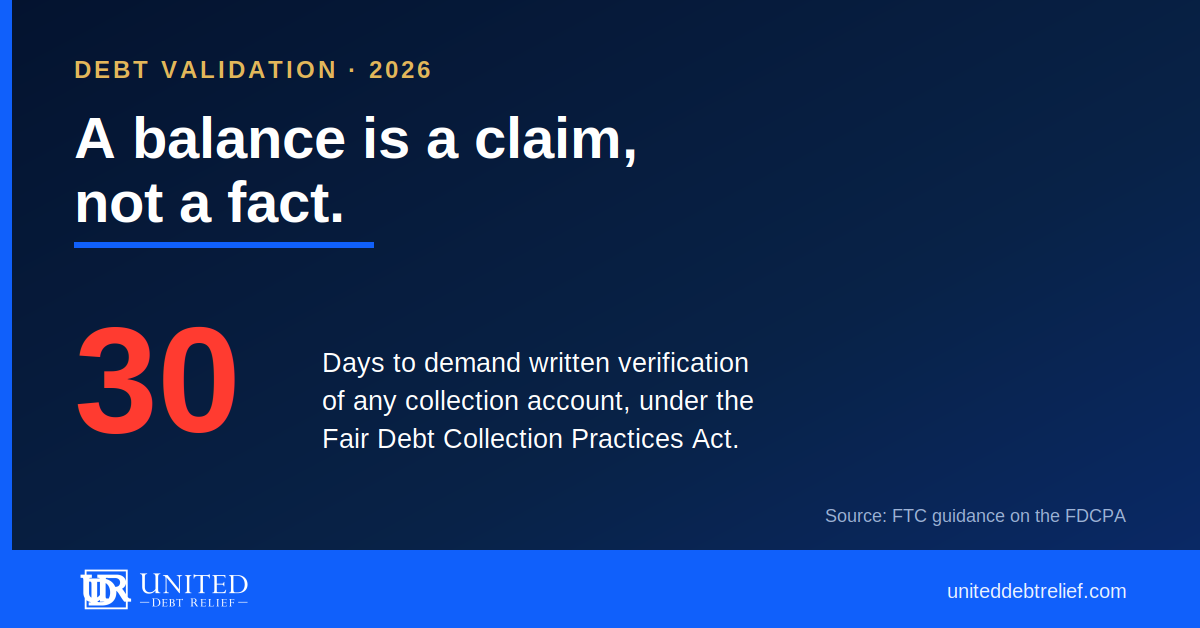

Federal law gives consumers 30 days to demand written verification of any collection account, and bars debt relief fees before a debt is actually settled.
SAN DIEGO, CA, UNITED STATES, September 15, 2026 /EINPresswire.com/ — Consumers carrying a collection account have a federal right that most never use. A consumer has 30 days from receiving a debt collector’s validation information to dispute the debt in writing, and once that dispute arrives the collector must stop collecting until it sends written verification, under the Fair Debt Collection Practices Act as described in Federal Trade Commission consumer guidance. United Debt Relief, a national debt relief company serving all 50 states, is publishing that rule and the federal limits on debt relief fees so consumers can measure any provider, and any collection notice, against the same standard.
How many complaints do collection accounts generate?
The Consumer Financial Protection Bureau received approximately 6,635,400 consumer complaints in 2025, of which approximately 387,400 concerned debt collection, according to the Bureau’s Consumer Response Annual Report published in March 2026. Credit or consumer reporting accounted for approximately 5,806,800 complaints, or 88% of the total.
What does the 30 day verification right actually do?
A debt collector must provide validation information at its first contact or within five days of it. The consumer then has 30 days to dispute in writing, and on receiving that dispute the collector must stop collection activity until it sends written verification, such as a copy of the original bill. The right has limits worth stating plainly. It does not erase a debt, and it does not decide who is correct. It requires a claim to be substantiated before collection continues.
“A balance is a claim, not a fact,” said Nick Avila, founder of United Debt Relief. “The first letter from a collector is a claim. Verification is what turns it into a fact, and federal law gives you 30 days to ask. Most people pay or panic instead, because nobody ever told them the letter was something they were allowed to question.”
What must happen before a debt relief company can charge a fee?
Under the Federal Trade Commission’s Telemarketing Sales Rule, a debt relief provider may not collect a fee until three conditions are met. The provider must have renegotiated, settled, reduced or otherwise changed the terms of at least one of the customer’s debts. The customer must agree to that result. And the customer must have made at least one payment to the creditor under the agreement. The same rule requires providers to state how long results will take and to disclose that credit reports and scores can be damaged when payments to creditors stop.
Why does this matter now?
Credit card balances rose by $21 billion to $1.26 trillion in the second quarter of 2026 even as total household debt fell by $13 billion to $18.8 trillion, according to the Federal Reserve Bank of New York’s Quarterly Report on Household Debt and Credit released August 11, 2026. The average annual percentage rate on card accounts assessed interest stood at 22.15% in the second quarter, with all accounts averaging 20.94%, according to Federal Reserve G.19 data released September 8, 2026.
What should a consumer ask any provider?
United Debt Relief recommends consumers get three things in writing before enrolling anywhere: the exact conditions that must be met before any fee is charged, the estimated time to a first result, and the expected effect on credit. Each is addressed in the FTC’s rule. Complaint records are searchable at no cost through the Consumer Financial Protection Bureau. Results vary by situation.
United Debt Relief maintains a public summary of U.S. consumer debt data at uniteddebtrelief.com/debt-data/ and an explanation of debt validation at uniteddebtrelief.com/debt-validation/.
About United Debt Relief
United Debt Relief is a national debt relief company serving all 50 states, offering five programs spanning debt settlement, debt validation, debt consolidation loans, tax resolution, and credit repair, so a client’s debt, tax, and credit problems are handled together rather than referred out. Its specialists consult with consumers, determine which program fits, and handle enrollment. Program services are performed by stringently vetted in-network providers and law firms, each BBB Accredited with an A rating. Debt settlement carries no upfront fees. Results vary by situation.
Nick Avila
United Debt Relief
+1 888-802-2092
info@uniteddebtrelief.com
Visit us on social media:
LinkedIn
Instagram
Facebook
X
Legal Disclaimer:
EIN Presswire provides this news content “as is” without warranty of any kind. We do not accept any responsibility or liability
for the accuracy, content, images, videos, licenses, completeness, legality, or reliability of the information contained in this
article. If you have any complaints or copyright issues related to this article, kindly contact the author above.

Media gallery